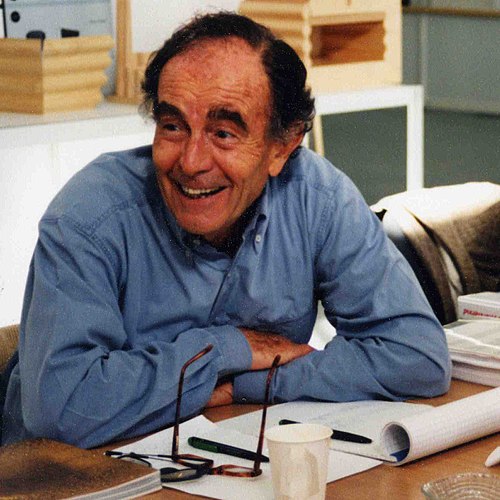
Vico Magistretti (1920-2006)
Vico Magistretti remains one of the Italian architects and designers whose writing durably structured Milanese design from the 1960s to the 1990s. An architect by training, professor at the Politecnico di Milano then at the Royal College of Art in London, he delivered at Cassina, Oluce, Artemide, De Padova, Campeggi, and Kartell a dense corpus where several pieces (Atollo, Maralunga, Selene, Eclisse, Carimate) received the major distinctions of Italian design (two Compasso d'Oro, in 1967 for the Eclisse lamp and in 1979 for the Atollo lamp). The LAPIERRE MARKET selection gathers authenticated Magistretti pieces, with systematic mention of editor, decade, and finish.
Biographical landmarks
Lodovico Magistretti, known as Vico, was born in 1920 in Milan into a family of architects (his father Pier Giulio Magistretti was an architect). He studied at the architecture faculty of the Politecnico di Milano, graduating in 1945, just after the end of the war. He immediately joined his father's studio and began practising as an architect in Milan.
From 1948-1950 onward, Magistretti participated actively in the post-war reconstruction of Milan. He signed the QT8 district (1947-1955) with other Milanese architects, then the Torre al Parco (1953-1956), the Santa Maria Nascente church in Cesate (1956), the Casa Arosio in Arenzano (1959-1960), the Touring Club Italiano building (1956-1962). This architectural practice, which lasted his whole life alongside design, explains the dimensional rigour that imbues his furniture.
Design entered his catalogue in 1959 with the Carimate chair for Cassina, red lacquered wood structure and woven straw seat. This first piece opened a more-than-thirty-year collaboration with Cassina, where he would notably deliver the Maralunga armchair (1973), the 905 chair (1964), the Sindbad chair (1981), the Veranda sofa (1983), and a Cab variant. The Maralunga won the Compasso d'Oro 1979.
At Artemide, Magistretti delivered the Selene chair (1969), the first single-piece stackable Italian plastic chair, as well as the Eclisse lamp (1965, Compasso d'Oro 1967) and the Chimera lamp. At Oluce, his collaboration began in 1977 with the Atollo lamp, which won the Compasso d'Oro 1979 and became one of the most reproduced Italian lamps in the world. The Mezzoracolo, Snow, and Pascal lamps followed. At De Padova, he signed the Raffles sofa (1988) and the Toledo beds. At Campeggi and Kartell, he developed other pieces in the 1990s-2000s.
Magistretti taught throughout his career. He was a professor at the Politecnico di Milano then at the Royal College of Art in London in the 1980s-1990s, where he trained a generation of European designers. He died in 2006 in Milan. A foundation, the Fondazione Studio Museo Vico Magistretti, was created in 2010 and today preserves his archives in Milan.
Signature pieces we source
Atollo (1977, Oluce). Table lamp with cylindrical aluminium base and hemispherical sitting diffuser. Three finishes: white lacquer, black lacquer, gold (limited edition). Compasso d'Oro 1979. Still edited by Oluce. Vintage 1977-1995 pieces quoted higher.
Maralunga (1973, Cassina). Armchair and sofa with manually folding adjustable backrest, high-density polyether foam, Tonus Kvadrat or velvet fabric. Compasso d'Oro 1979. Iconic piece of the 1970s Italian living room.
Carimate (1959, Cassina). Chair with red lacquered wood structure and woven straw seat, originally designed for the Carimate golf club. Reissued by Cassina in several colours.
Selene (1969, Artemide then Heller). First single-piece stackable Italian plastic chair. Original colours: white, red, black, green, orange. Original Artemide vintage pieces distinct from recent Heller productions.
Eclisse (1965, Artemide). Table lamp in orange or white lacquered aluminium, with rotating internal diffuser that modulates lighting. Compasso d'Oro 1967. Iconic piece of 1960s Italian design.
Mezzoracolo (1970, Oluce). Lamp with conical base and opal hemispherical diffuser. A rarer Atollo variant, a collector piece.
Chimera (1969, Artemide). Sculptural floor lamp in moulded methacrylate. A rare sculptural piece in limited production.
Sindbad (1981, Cassina). Armchair and sofa with tubular structure and cushions, inspired by English horse blankets. Less iconic but a clear Magistretti signature.
Veranda (1983, Cassina). Sofa with adjustable backrest, later than the Maralunga, different technical structure. Limited production.
Authentic vs reissue vs homage
The Magistretti market separates three levels by editor. The vintage piece stamped by its original editor (Cassina, Oluce, Artemide, De Padova, Campeggi, Kartell) with dating by stamp typology and finish. Highest quotation. The recent reissue, in particular the Atollo at Oluce and the Maralunga at Cassina, marked explicitly with contemporary finish. Intermediate quotation. The unauthorised copy, particularly present on the Atollo, which is one of the most copied Italian lamps in the world, sold online without a stamp. LAPIERRE MARKET never lists copies; every piece listed carries its verified editor stamp.
LAPIERRE MARKET process for Vico Magistretti pieces
Three stages structure expertise. Identification of the editor via the engraved, glued, or moulded stamp (Cassina, Oluce, Artemide, De Padova, Campeggi, Kartell). Dating by stamp typology and finish (original aluminium paint for the Atollo, period Cassina fabrics for the Maralunga). Detailed photographic documentation. Cross-referencing with Cassina, Oluce archives, and the Fondazione Studio Museo Vico Magistretti in Milan.
Request a Vico Magistretti piece
For a specific search (limited-edition gold Atollo, pair of vintage Maralunga in red velvet, set of six original-white Selene Artemide chairs), write to us. LAPIERRE MARKET activates its Italian network specialised in Milanese design, on a four-to-twelve-week horizon depending on rarity.
FAQ