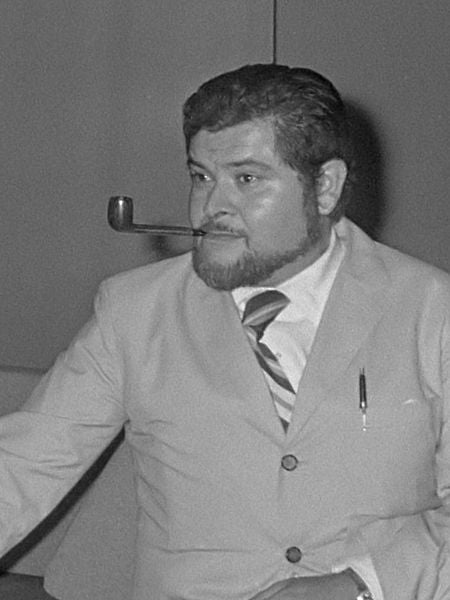
Joe Colombo (1930-1971)
Joe Colombo remains one of the most prolific and most prospective figures of 1960s Italian design. With a short career (1962-1971) cut off by his early death at forty-one, he delivered more than one hundred signed pieces at Kartell, Oluce, Flexform, Zanotta, B-Line, Alessi, and Boffi, several of which remain absolute icons of Italian design: the Spider lamp, the Universale 4860 chair, the Tube armchair, the Boby cart. The LAPIERRE MARKET selection gathers authenticated Colombo pieces, with systematic mention of editor, decade, and material, in a catalogue dominated by 1960s-1970s plastic and lacquered aluminium.
Biographical landmarks
Cesare Colombo, known as Joe Colombo, was born in 1930 in Milan into an industrial family (his father ran an electrical-equipment factory). He first studied painting at the Accademia di Belle Arti di Brera between 1949 and 1954, where he was part of the Movimento Nucleare with Enrico Baj and Sergio Dangelo. This initial training in painting, then in architecture at the Politecnico di Milano (graduating in 1959), structured his approach to design: for Colombo, furniture is a plastic and architectural object before it is a function.
He began practising as an architect, then took over the family business in 1958-1959, where he developed expertise in industrial techniques (plastic moulding, metalwork, electricity). In 1962, he founded his design studio in Milan, which quickly became one of the most prolific of the decade. His first major piece, the Elda chair (1963, Comfort), a leather and fibreglass armchair, launched his Milanese reputation.
Between 1963 and 1971, Joe Colombo developed a dense corpus distributed across several editors. At Kartell, he delivered the Universale 4860 chair (1967), the world's first chair entirely moulded in thermoplastic without assembly, and the table 4905. At Oluce, he signed the Spider lamp (1965), the Coupé (1967), the Topo (1970), and several methacrylate lamps (Acrilica, Kd 27, Kd 29). At Flexform, the Tube armchair (1969), a modular assembly of four leather-covered tubes. At Zanotta, the Birillo stool (1971). At B-Line, the Boby cart (1970). At Boffi, the Mini-kitchen (1963), a modular kitchen unit on wheels.
His practice culminated in prospective projects that anticipate contemporary issues of compact and modular housing. The Visiona 1 (1969, Bayer) proposed a futurist living cell for the Cologne fair. The Total Furnishing Unit (1971, MoMA), prototype 28-sqm modular living unit integrating kitchen, sleeping, bathroom, and storage, was exhibited at MoMA in 1972 and remains a museum reference.
Joe Colombo died on 30 July 1971 in Milan, on his forty-first birthday, of a heart attack. His career lasted less than ten years. His wife Ignazia and his brother Gianni Colombo continued to edition his pieces and develop his posthumous projects, including the Total Furnishing Unit. A retrospective was devoted to him at the Triennale di Milano in 2005-2006.
Signature pieces we source
Spider (1965, Oluce). Lamp with articulated arm in black or white lacquered metal, orientable reflector. Table, floor, wall versions. Still edited by Oluce. Vintage 1965-1985 pieces quoted higher.
Universale 4860 (1967, Kartell). World's first chair entirely moulded in thermoplastic without assembly. Original colours: red, orange, white, black, deep green, yellow. ABS until 1979 then polypropylene.
Tube Chair (1969, Flexform). Armchair in four modular leather-covered tubes, to be assembled in several configurations. A rare piece sought after by collectors.
Coupé (1967, Oluce). Table lamp with directional reflector, lacquered-metal structure. Less common than the Spider but a clear Colombo signature.
Boby cart (1970, B-Line). Modular office cart on wheels in ABS plastic. Heights Boby 11, Boby 22, Boby 33. Colours red, orange, white, black, grey. Still edited.
Topo (1970, Oluce). Office lamp in methacrylate with articulated arm. A round sculptural piece. Still edited.
Acrilica (1962, Oluce). Office lamp in transparent methacrylate in the shape of a question mark. Very rare in original edition.
Birillo Bar Stool (1971, Zanotta). Bar stool with tubular structure and upholstered shell. Living-room and bar piece.
Mini-kitchen Boffi (1963, Boffi). Complete kitchen on wheels that closes into a block, integrating hob, sink, and refrigerator. A rare collector piece.
Authentic vs reissue vs homage
The Colombo market separates three levels by editor. The vintage piece stamped by its original editor (Kartell, Oluce, Flexform, Zanotta, B-Line, Boffi) with dating by stamp typology and material. Highest quotation. The recent reissue, in particular the Spider at Oluce and the Universale 4860 at Kartell, marked explicitly with contemporary finish. Intermediate quotation. The unauthorised copy, sold online without a stamp, with thinner plastic and approximate finish. LAPIERRE MARKET never lists copies; every piece listed carries its verified editor stamp.
LAPIERRE MARKET process for Joe Colombo pieces
Three stages structure expertise. Identification of the editor via the moulded, engraved, or glued stamp (Kartell, Oluce, Flexform, Zanotta, B-Line, Boffi). Dating by stamp typology and material (original ABS vs polypropylene for the Universale, vintage methacrylate for Oluce). Detailed photographic documentation. Cross-referencing with reference scholarship (Triennale di Milano, Oluce and Kartell archives, Joe Colombo catalogues raisonnés).
Request a Joe Colombo piece
For a specific search (vintage Spider Oluce in white, set of six original ABS orange Universale 4860, Flexform Tube Chair), write to us. LAPIERRE MARKET activates its Italian network specialised in 1960s-1970s design, on a four-to-twelve-week horizon depending on rarity.
FAQ