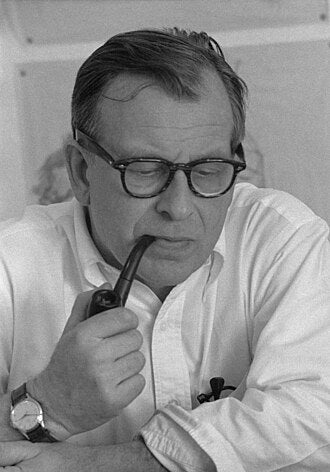
Eero Saarinen (1910-1961)
Eero Saarinen remains one of the major figures of post-war American design and architecture. Born in Finland, trained at the Cranbrook Academy of Art alongside Charles Eames, Florence Knoll, and Harry Bertoia, he developed at Knoll a furniture language that favours structural continuity and central pedestals over the four traditional legs. This research, which he called "the slum of legs," gave rise to the Tulip table, Tulip chair, and Womb Chair, three pieces that still structure the vintage Knoll market today. The LAPIERRE MARKET selection gathers authenticated Knoll Saarinen pieces, with systematic mention of editor, decade, and top material.
Biographical landmarks
Eero Saarinen was born in 1910 in Kirkkonummi, Finland, son of architect Eliel Saarinen, one of the major figures of early 20th-century Finnish architecture. The family emigrated to the United States in 1923, when Eliel received the Cranbrook Academy of Art commission in Michigan. Eero grew up in this environment where the founding figures of post-war American design crossed paths: Charles and Ray Eames, Florence Knoll, Harry Bertoia, Edmund Bacon. This Cranbrook network durably structured his career and that of his contemporaries.
Eero studied sculpture at the Académie Grande Chaumière in Paris in 1929-1930, then architecture at Yale, graduating in 1934. He joined the family agency in Bloomfield Hills, where he worked alongside his own projects. In 1940, he participated in the MoMA Organic Design in Home Furnishings competition with Charles Eames, where they presented moulded plywood research that prefigured Charles and Ray Eames's later pieces for Herman Miller.
The encounter with Florence Knoll (then Florence Schust before her marriage to Hans Knoll) at Cranbrook structured his entry at Knoll. In 1946, he signed the Grasshopper Lounge Chair, his first piece for Knoll. In 1948, on direct commission from Florence Knoll who wanted a chair she could curl up in, he developed the Womb Chair. In 1957, after several years of research to reduce the slum of legs, he delivered the Pedestal collection comprising the Tulip table, Tulip chair, and Tulip stool, all on a central cast aluminium lacquered pedestal.
In architecture, Saarinen founded his own practice in 1950 after his father's death. His major projects include the MIT Chapel (1955), the General Motors Technical Center (1956), the TWA terminal at JFK New York (1962), the Dulles Washington terminal (1962), and the Gateway Arch in Saint Louis (1965, completed after his death). Eero Saarinen died in 1961 of a brain tumour at the age of fifty-one, in full activity.
Signature pieces we source
Tulip round table (1957, Knoll). Calacatta, Empereur Brun, Vert Alpi marble top, white laminate, or wood on a central cast aluminium lacquered pedestal. Diameters 90 cm, 107 cm, 137 cm. The 137 cm in Calacatta marble remains the most sought-after configuration. Dining height 74 cm.
Tulip oval table (1957, Knoll). Oval variant 198 x 121 cm for six-to-eight-person dining rooms. Central piece in complete Saarinen interiors. High quotation in Calacatta or Empereur Brun marble.
Tulip chair (1957, Knoll). Chair complementary to the Tulip table, central lacquered aluminium pedestal and upholstered shell. Available in several Knoll fabrics depending on period. Often sought in sets of four, six, or eight.
Womb Chair (1948, Knoll). Cocoon armchair with moulded fibreglass shell, latex foam and Knoll Tonus fabric, on a four-branch chromed steel base. Standard edition and rarer Petit Womb version. Matching ottoman available. Iconic piece commissioned by Florence Knoll.
Womb Ottoman (1948, Knoll). Pouf matching the Womb Chair, identical structure and materials, lower and shorter. Often sought to complete an armchair-ottoman pair.
Tulip stool (1957, Knoll). Bar stool with Tulip pedestal, bar height (76 cm) or counter height (66 cm). Less common than the Tulip chair but consistent with the complete set.
Executive 71 Series (1951, Knoll). Series of upholstered office chairs and armchairs with four-branch aluminium star base. Less iconic but documented in Knoll archives.
Grasshopper Lounge Chair (1946, Knoll). Saarinen's first piece for Knoll, low armchair with bent-wood structure and cushions. A rare collector piece in limited production.
Authentic vs reissue vs homage
The Saarinen market separates three levels. The vintage Knoll piece from 1957-1990, identifiable by original round Knoll Associates or Knoll International label, original cast aluminium lacquered pedestal, real marble. Highest quotation. The recent Knoll reissue, marked by a more modern label, manufactured to the same specifications with finish evolutions. Intermediate quotation but Knoll authenticity preserved. The unauthorised copy, sold online without a Knoll label, with plastic or light-aluminium pedestal, sometimes imitation marble top. This segment represents a significant share of online volume sold under the Tulip name. LAPIERRE MARKET never lists copies; every Tulip listed carries its verified Knoll label.
LAPIERRE MARKET process for Eero Saarinen pieces
Three stages structure expertise. Verification of the Knoll label (dating by label typology: Knoll Associates 1947-1955, Knoll Associates Inc. 1955-1969, Knoll International 1969-1980, recent Knoll). Physical inspection of the aluminium pedestal and marble (density, natural veining, original polishing). Documentation of cushions and fabrics for the Womb, with mention if reupholstery has occurred. Cross-referencing with Knoll archives when accessible.
Request an Eero Saarinen piece
For a specific search (vintage 137 cm round Tulip in Calacatta, pair of Womb in original red Tonus, set of six Tulip chairs in black fabric), write to us. LAPIERRE MARKET activates its Knoll network and partner American, Italian, and French galleries, on a four-to-ten-week horizon depending on rarity.
FAQ