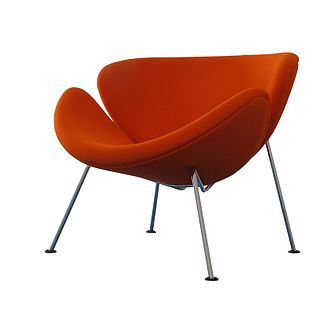
Pierre Paulin (1927-2009)
Pierre Paulin remains one of the French designers who structured the language of European sculptural seating in the 1960s-1970s. His approach, developed with Artifort under the artistic direction of Kho Liang Ie, rests on a precise technical innovation: an internal tubular structure stretched with moulded foam and covered in stretch jersey or Tonus Kvadrat. This technique enabled the Tongue, Mushroom, Ribbon, and Pumpkin silhouettes that remain today the absolute references of vintage French furniture. The LAPIERRE MARKET selection gathers authenticated original Paulin pieces and documented Artifort reissues, with systematic mention of period and editor.
Biographical landmarks
Born in 1927 in Paris, Pierre Paulin trained initially in ceramics and stone-cutting before joining the École Camondo in the 1950s under Marcel Gascoin's direction. This dual training, manual then theoretical, marked his relationship to material. He began his professional career at Thonet in the late 1950s, designing bent-wood chairs that remain little known but document his beginnings.
The decisive encounter took place in 1958 with Artifort, the Dutch editor led by Henk Wagemans, who entrusted him with the development of the seating catalogue. Under Kho Liang Ie's artistic direction, Paulin developed between 1958 and 1975 the iconic corpus that still structures the market today. The Mushroom F560 came out in 1959, the Ribbon F582 in 1966, the Tongue F577 in 1967, the Pumpkin F310 in 1971, the Big Ribbon F595 in 1975. This series combined industrial innovation (stretched tubular structure, moulded foam, stretch jersey) with sculptural authorship.
Paulin received two major presidential commissions that marked the history of French state furniture. In 1971, Georges Pompidou commissioned him to design the Élysée Palace's private apartments, with the Mobilier National's collaboration. Paulin developed there the ABCD series (F780, F784), a modular orange-brown furniture that became an emblem of design presidency. In 1983, François Mitterrand commissioned the presidential desk and several complementary furniture pieces.
From the 1990s onward, Paulin worked in parallel on more confidential projects and founded with his wife Maïa and son Benjamin the studio that became Paulin Paulin Paulin, a family editor that still publishes archive pieces today. Pierre Paulin died in 2009 in Montpellier. A retrospective was devoted to him at the Centre Pompidou in 2016.
Signature pieces we source
Tongue F577 (1967, Artifort). Low armchair in moulded foam covered in Tonus stretch jersey, with the silhouette of a tongue lying on the floor. Initial production in several bright colours (red, orange, yellow, blue, green). Vintage pieces in original Tonus reach high quotations; Artifort reissues have been available since the 2000s.
Mushroom F560 (1959, Artifort). Mushroom armchair, the first model in Paulin's tubular-stretched language. Child versions F558 are rarer. Original colours (orange, yellow, red, brown) are the most sought after.
Big Ribbon F595 (1975, Artifort). Ribbon armchair, an evolution of the Ribbon F582, wider and more enveloping. On wood or metal base depending on period. A central piece in Paulin interiors.
Ribbon F582 (1966, Artifort). The original ribbon armchair, more compact than the Big Ribbon. Bent-wood base. Vintage pieces in original Tonus are scarce and reach high quotations.
Pumpkin F310 (1971, Artifort). Pumpkin armchair, round and low, moulded foam and stretched fabric. Also produced as two- and three-seater sofas. Recommended for soft, layered interiors.
ABCD F780-F784 (1971-1972, Mobilier National then Artifort). Modular series designed for the Élysée presidential apartments under Pompidou. Letters A, B, C, D are assembled to compose sofas, benches, armchairs. Original Mobilier National pieces are rare; Artifort reissues are more accessible.
Tulip F549 (1965, Artifort). Tulip chair with central tube base and moulded foam shell, more accessible than the sculptural armchairs. Available in several original fabrics.
CM 131 (Thonet, 1950s). Bent-wood chair from Paulin's first period at Thonet. A lesser-known piece that documents his beginnings; moderate quotation.
Authentic vs reissue vs homage
The Paulin market separates three levels. The original Artifort from the 1960s-1970s, identifiable by the original label sewn under the seat, the period tubular structure, and the original Tonus Kvadrat or stretch jersey. These pieces reach high quotations and form the sought-after segment. The Artifort reissue from the 2000s onward, marked explicitly by a recent editor label, manufactured with contemporary techniques and current Kvadrat. Lower quotation but more accessible. The unauthorised copy or homage, which circulates online without signature, with approximate tubular structure and imitation fabric. LAPIERRE MARKET never lists copies; every piece is either vintage Artifort, reissue Artifort, or Mobilier National for original ABCD pieces, with explicit period mention on the listing.
LAPIERRE MARKET process for Pierre Paulin pieces
Three stages structure expertise. Verification of the Artifort or Mobilier National label and of the internal tubular structure via physical inspection. Photographic documentation of Tonus or jersey, seams, and patina. Cross-checking with reference scholarship (Cloé Pitiot, Artifort catalogues raisonnés, Mobilier National Élysée archives). Pieces with signature doubts or undocumented re-Tonus jobs are never listed without explicit mention.
Request a Pierre Paulin piece
For a specific search (Tongue F577 in original red Tonus, pair of Mushroom F560, vintage Big Ribbon F595), write to us. LAPIERRE MARKET activates its Artifort network and partner French and Dutch galleries on request, on a four-to-ten-week horizon depending on rarity.
FAQ