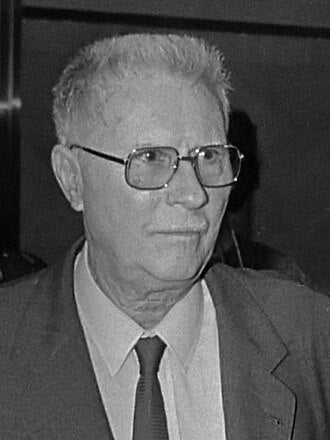
Jean Prouvé
Jean Prouvé (1901-1984) is a French builder, designer, and architect who profoundly refounded the relationship between industrial manufacturing and authorial design in 20th-century France. His work — Standard chairs, Cité and Antony armchairs, Trapèze tables, Compas desks, but also demountable houses and architectural systems — embodies a coherent approach where the manufacturing process entirely determines the final form. LAPIERRE MARKET sources and documents original Jean Prouvé pieces for collectors and architects.
History and training
Jean Prouvé was born on 8 April 1901 in Paris into a family of artists — his father Victor Prouvé was a painter and president of the École de Nancy, an artistic movement that profoundly marked Nancy at the Belle Époque. Rather than following an academic education, he learned the trade of art ironworker with Émile Robert in Enghien-les-Bains (1916-1919) then with Adalbert Szabo in Paris (1919-1923). In 1924, at 23, he founded his own Ateliers Jean Prouvé at 50 rue du Général-Custine in Nancy, first dedicated to art ironwork then quickly switching to folded steel sheet and light metal construction.
His first furniture pieces date from the early 1930s, in the wake of the Modern Movement and UAM (Union des Artistes Modernes), of which he was a member from 1929. The Cité chair (1930), designed for the Aix-en-Provence university residence, marks Prouvé's entry into architect's furniture. The Standard chair (CB22, 1934) and its Métropole evolution (1953) durably inscribe his formal vocabulary: front legs in fine tube, rear legs in folded curved steel sheet — a signature recognisable at first glance. The logic: maximum load is exerted on the rear legs, so they must be more robust; instead of using the same profile everywhere, Prouvé adapts form to function.
The Maxéville Atelier (1947-1956)
Post-war, Prouvé extended his Ateliers by building a new factory in Maxéville (1947), a Nancy suburb. It is in this factory that he developed his most ambitious architectural systems: the Maison Tropicale (1949-1951, designed for the French colonial ministry in West Africa), the Refuge Tonneau (1938 but produced at Maxéville), the foam-panel system for reconstruction. His associate Pierre Jeanneret (Le Corbusier's cousin) joined the atelier in 1947.
The Maxéville atelier produced in parallel a catalogue of industrial furniture destined for collectivities: universities, hospitals, high schools, but also administrative offices (Direction, Présidence, Compas collection). The Compas desk (1953) — rectangular top rested on two compass-inverted legs in folded sheet — became the architect's desk par excellence and remains one of the most reproduced Prouvé pieces in Vitra reissue.
In 1953, Prouvé lost control of Maxéville following a conflict with his banker Studal, who removed his majority capital. He left the atelier he had created and worked thereafter as architectural consultant for CIMT (Compagnie Industrielle de Matériel de Transport) from 1954.
Architect-consultant period and Beaubourg (1956-1984)
After 1956, Prouvé no longer had a production atelier and dedicated himself to architectural consulting missions and teaching. He was named in 1971 president of the international jury for the Centre Pompidou competition, which selected the Piano-Rogers project — a bold and historic choice. He taught at CNAM (Conservatoire National des Arts et Métiers) until 1971 and continued designing, notably façade elements for the Lycée du Bourget and several prefectures.
He died on 23 March 1984 in Nancy, aged 82.
Iconic pieces we source
- Standard Chair (CB22, 1934-1956): four-legged chair, folded steel sheet structure, curved rear legs, moulded plywood seat and backrest.
- Métropole Chair (305, 1953): evolution of the Standard, simplified version for collectivities.
- Cité Armchair (1930): low armchair with metal structure, leather straps, created for the Aix-en-Provence university residence.
- Antony Armchair (1954): sculptural armchair created for the Antony university residence, lacquered folded sheet structure, single-piece moulded plywood seat and backrest.
- Compas Desk (1953): architect's desk, wood or metal top resting on inverted compass folded sheet legs.
- Présidence Desk (1953): extended version with drawer cabinet.
- Trapèze Table (1954): versatile table, trapezoidal folded sheet legs, walnut, beech, or laminate top.
- Stool 307 (1951): low stool with folded sheet legs.
- Cafétéria 512 (1953): stackable table.
Recognising the authentic
An original Jean Prouvé piece presents: folded and welded steel sheet according to characteristic profiles (signature curved legs), thick oven-baked industrial paint (original or repainted in original RALs), internal or under-piece marking (rare on surface). Originals carry their traceability — original institution, university, hospital, school — which constitutes the key authentication element. Galerie Patrick Seguin (rue de Charonne, Paris) and Galerie Jousse Entreprise (rue Saint-Claude, Paris) maintain reference catalogues raisonnés. Vitra reissues (since 2002) are marked Vitra and feature tighter manufacturing tolerances than originals.
LAPIERRE MARKET process for this brand
Sourcing in France from decommissioned institutions (universities, hospitals, renovated high schools), estates of architects who worked with Prouvé, and more rarely export. Systematic authentication by traceability cross-referencing (documented provenance, historical photographs when available), manufacturing characteristics (sheet thickness, fold profiles, original paint), and references to the Patrick Seguin catalogue. Limited restoration: cleaning, repainting if original paint is too degraded (in period RALs), plywood replacement only if the original is broken. Authentic industrial use patinas are systematically preserved — they make the piece's value.
Request a search
Our Prouvé sourcing is sporadic. If you're looking for a specific piece (original Standard in blue, complete Antony, Compas Direction), contact us — we maintain a waiting list and activate our French channels when a client specifies their request. For architectural offices, we can also document and source coherent series (sets of 6, 8, 12 Standard chairs of the same vintage).
FAQ